Relationship between household attributes and contact patterns in urban and rural South Africa
Abstract
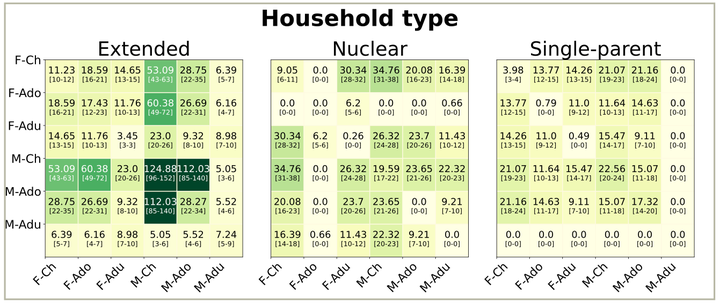
Households play a crucial role in the propagation of infectious diseases due to the frequent and prolonged interactions that typically occur between their members. Recent studies have emphasized the need to include socioeconomic variables in epidemic models to account for the heterogeneity induced by human behavior. While sub-Saharan Africa suffers the highest burden of infectious disease diffusion, few studies have investigated the mixing patterns in the countries and their relation with social indicators. This work analyzes household contact matrices measured with wearable proximity sensors in a rural and an urban village in South Africa. Leveraging a rich data collection describing additional individual and household attributes, we investigate how the household contact matrix varies according to the household type (whether it is composed only of a familiar nucleus or by a larger group), the gender of its head (the primary decision-maker), the rural or urban context, and the season in which it was measured. We show the household type and the gender of its head induce differences in the interaction patterns between household members, particularly regarding child caregiving, suggesting they are relevant attributes to include in epidemic modeling.

Lorenzo Dall'Amico
Postdoctoral fellow
I am currently a postdoctoral fellow at the ISI foundation in Turin, Italy.